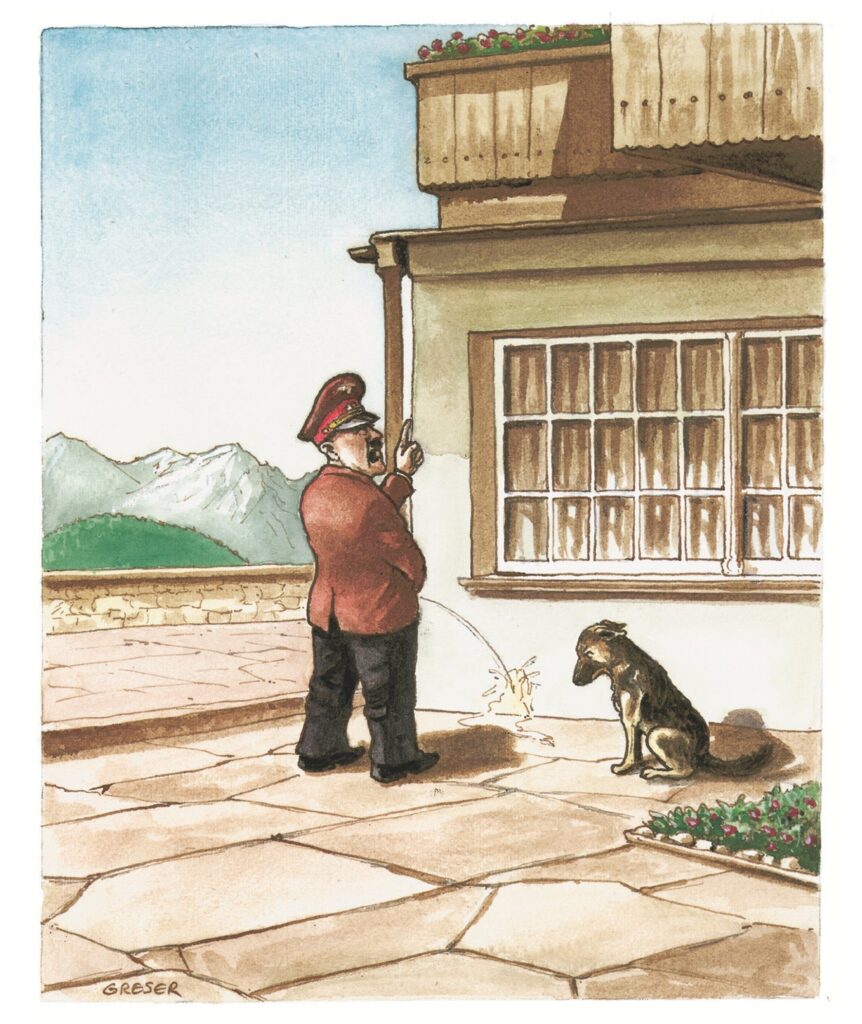
My Territory!

Caricature depicting Adolf Hitler urinating against the exterior wall of the Berghof, with his dog Blondie sitting beside him. Achi Greser, 1998

Achim Greser’s Hitler Cartoons at Obersalzberg

26 November 2026 – 11 April 2027

Is it acceptable to laugh at Hitler? And where are the limits of satire when it comes to a dictator responsible for war and the Holocaust?

This special exhibition explores these questions through the caricatures of Achim Greser. Between 1995 and 1998, he drew the Nazi dictator for the satirical magazine Titanic every month as a joke figure and a knucklehead in a series called Der Führer privat (The Private Life of the Führer).

“I think it’s just a wee bit too degenerate, honey.”

Whether depicted as the domineering owner of his German shepherd Blondi or as a peculiar resident of the Berghof at Obersalzberg, Greser places Hitler in situations that turn his carefully cultivated self-image into absurdity.

But are we really allowed to make fun of Hitler? Or does portraying him as a simpleton also make his victims seem ridiculous and trivialize Nazi atrocities, war, and genocide?This question was a subject of fierce debate both in Germany and internationally.

Caricature depicting Adolf Hitler painting a mountain landscape. The painting looks like a child's drawing. Eva Braun stands beside him, dismissing it as too “degenerate.” Achim Greser, 1996

Nazi crimes scarcely feature in Greser’s cartoons: he isn’t laughing at Auschwitz. Rather, by making fun of him, he debunks our image of Hitler as an arch-villain. Greser’s aim is to topple this personification of evil from his pedestal and thereby to mock both old and new Hitler fans by treating “their Führer” with contempt.

Fifty years after the war, ridicule is the name of the game in Greser’s cartoons. In a bid to break with the enduring media presence of Hitler propaganda images, he creates scenes that hold up a distorting mirror to criticism of current issues, transposing the 1990s into his drawings of the past. To amplify the provocative effect, he uses grotesque images of Hitler to satirize moralizing, doctrinaire, or bigoted political and social attitudes.

“Cannonball, Adolf”

Greser captures Hitler’s poses and self-projection with great precision, with the characteristic mountain landscape often serving as a backdrop. Nazi propaganda had already used Obersalzberg as a setting for the photo book Hitler, wie ihn keiner kennt (The Hitler No-one Knows).

Caricature depicting Hitler wearing inflatable armbands on a lakeside jetty, while Göring, Himmler and Goebbels are swimming in the lake. Achim Greser, 1995

Are you interested in our work?

You will find us on YouTube, Facebook and Instagram. Here we post information about the history of Obersalzberg as well as current news and details of forthcoming events. Come and take a look!

II
The Obersalzberg Documentation Center is not affected by the fire at the Eagle’s Nest and is open as usual.