Idyll & Atrocity

The permanent exhibition
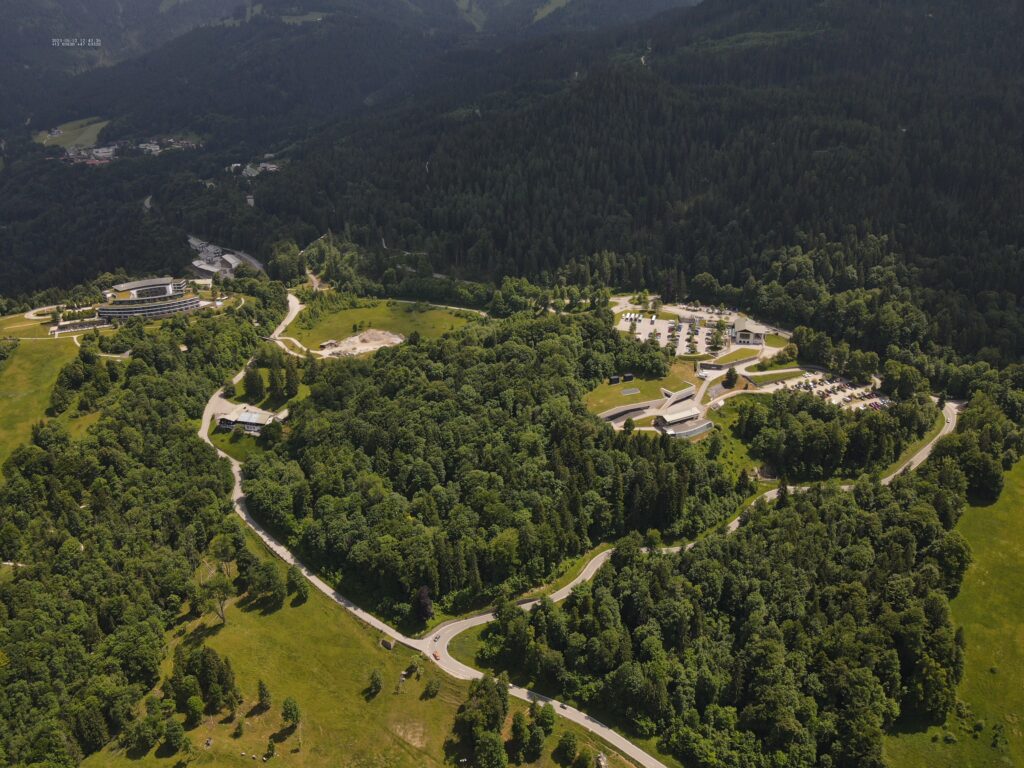
Between 1933 and 1945 Obersalzberg was a Nazi power center. Adolf Hitler spent more than a quarter of his time in office here. At the Berghof, his retreat in the Berchtesgaden Alps, Hitler and his closest associates took decisions that led to persecution, war and genocide.
At the same time, Obersalzberg provided a backdrop to project an image of Hitler as an allegedly congenial “chancellor of the people”. This false image was disseminated millions of times in photographs and film footage and still has an impact today.
The permanent exhibition of the Obersalzberg Documentation Center informs visitors in five chapters about the history of this historic location where the marvelous landscape is closely connected with the horrors of Nazi rule.


In the space of just a few years Obersalzberg was transformed from a mountain farming village into a rigorously guarded, cordoned-off area for the Führer. In the center of this area was Hitler’s Berghof, a peculiar combination of private residence and seat of government where he held court and ruled Germany. The last part of this chapter shows how Nazi “Führer” propaganda was staged, produced and conveyed to ordinary people.

The “national comrades”, as ethnic Germans were known, flocked to Obersalzberg in “pilgrimages” to see Hitler, their “Führer” or leader. Here, as elsewhere in the Reich, the racist construct of a “national community” was put into practice. Political dissenters, alleged “anti-social elements” and so-called “enemies of the race”, primarily “the Jews”, were ostracized, mercilessly persecuted and murdered.
 Dokumentation Obersalzberg / Foto: Kradisch
Obersalzberg was a place where foreign policy was conducted and war was waged. Here Hitler pursued his expansionist policies. He received state guests and allies, and he prepared the war that he wanted to wage: the invasion of Poland and the campaign against the Soviet Union. Hitler waged war at the map table of the Berghof.

There is no aspect of Nazi mass atrocities that is not connected with Obersalzberg. This chapter, at the center of the exhibition, focuses on the places where the nazis committed their crimes as well as on the fate of their victims. All over Europe, millions of people perished and suffered as a result of the murderous decisions taken at Obersalzberg.

At Obersalzberg, like elsewhere, the war ended in 1945. Hitler had left the Berghof almost a year previously. When US and French troops captured the Führer’s off-limits area they encountered no resistance. In the following decades the question arose of what to do with this site, which was in danger of becoming a “theme park of history”.

The exhibition concludes with a tour of the bunkers. There, the many inscriptions and graffiti on the walls tell the story of these underground shelters. Two installations provide information about forced labor and about aerial warfare.
Häufige Fragen
Wir empfehlen für den Ausstellungsbesuch inklusive Bunkerrundgang etwa 1,5 bis 2 Stunden einzuplanen. Etwa 40 Minuten dauert ein Kurzrundgang mit unserem Multimediaguide.
Die Ausstellung “Idyll und Verbrechen” verzichtet auf explizites Bildmaterial, beschäftigt sich aber mit den Themen Verfolgung, Krieg und Massenmord. Wir empfehlen den Besuch der Ausstellung ab 12 Jahren. Für Kinder ab 8 Jahren bieten wir einen altersgerechten Rundgang im Mediaguide an.
Alle Informationen dazu finden Sie hier.
Leider können Sie Ihren Hund oder andere Tiere nicht mit in unsere Ausstellung nehmen. Anerkannte Assistenzhunde mit Nachweis sind in unserem Haus willkommen. Mehr zur Barrierefreiheit
Das Fotografieren ohne Blitz oder andere Leuchtmittel ist erlaubt. Die Aufnahmen dürfen ausschließlich für den privaten Gebrauch verwendet werden.
Sperrige Gegenstände, Rucksäcke und große Taschen dürfen nicht mit in die Ausstellung genommen werden. Dies gilt auch für sogenannte Kraxen und Kindertragen, sofern sie auf dem Rücken getragen werden.
Bitte haben Sie Verständnis, dass diese Regelung dem Schutz der anderen Besucherinnen und Besucher sowie der Ausstellungseinbauten und Exponate dient.
Im Untergeschoss finden Sie Getränke- und Snackautomaten.
Bei einem gebuchten Rundgang gibt es keine Mindestteilnehmendenzahl.
Weitere Informationen
Wir bieten regelmäßig öffentliche Rundgänge für Einzelbesuchende durch die Dauerausstellung und Bunkeranlage an.
Bei der Bunkeranlage handelt es sich um ein historisches Bauwerk. Teilweise ist der Boden uneben und an manchen Stellen gibt es Stege mit Gitterboden. Wir empfehlen geeignetes Schuhwerk.